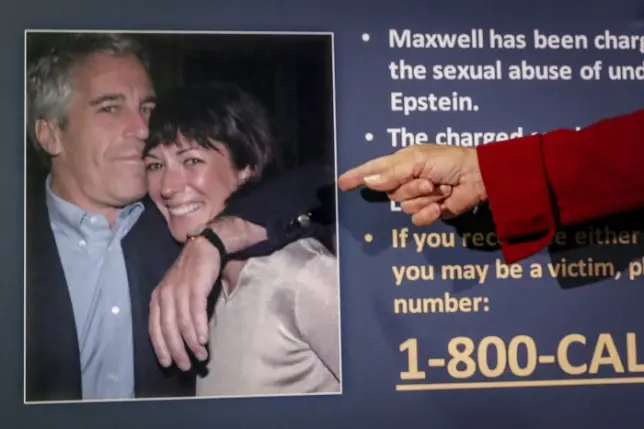
(File Photo: Source for Photo: FILE – Audrey Strauss, acting U.S. attorney for the Southern District of New York, points to a photo of Jeffrey Epstein and Ghislaine Maxwell, during a news conference in New York on July 2, 2020. (AP Photo/John Minchillo, File)
(AP) A subcommittee of the House Committee on Oversight voted Wednesday to subpoena the Department of Justice for files in the sex trafficking investigation into Jeffrey Epstein.
Three Republicans on the panel voted with Democrats for the subpoena, sending it through on an 8-2 vote tally. Republican subcommittee chairman, Rep. Clay Higgins of Louisiana, said that work to draft the subpoena was beginning.
The vote came just hours before the House was scheduled to end its July work session and depart Washington for a monthlong break. House Speaker Mike Johnson has adjourned Major business in the House ahead of Congress’ August recess to avoid contentious votes on Epstein-related matters as the President Donald Trump ‘s administration faces intense public pressure to release more information about the sexual predator.
Earlier Wednesday, a judge rejected the Justice Department’s request to unseal transcripts from grand jury investigations of Epstein years ago in Florida, saying the request doesn’t meet any of the extraordinary exceptions under federal law that could make them public. A similar records request is still pending in New York.
Here’s the latest:
US automakers say Trump’s 15% tariff deal with Japan puts them at a disadvantage
U.S. automakers have said the tariffs on Japanese vehicles at 15% would put them at a competitive disadvantage, saying they will face steeper import taxes on steel, aluminum and parts than their competitors.
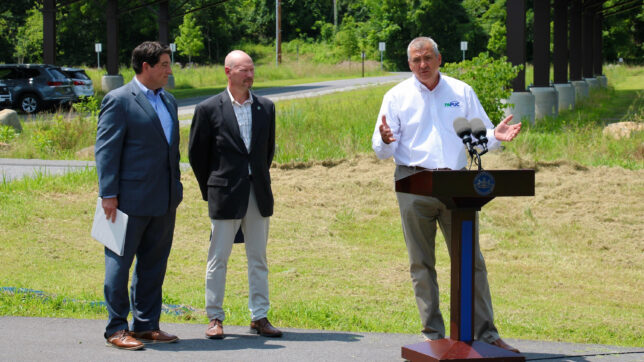
Matt Blunt, president of the American Automotive Policy Council — which represents General Motors, Ford and Jeep-maker Stellantis — said in an interview that the U.S. companies and workers “definitely are at a disadvantage” because they face a 50% tariff on steel and aluminum and a 25% tariff on parts and finished vehicles. There are some exceptions for products covered under the United States-Mexico-Canada Agreement that went into effect in 2020.
The domestic automaker reaction reveals the challenge of enforcing policies across the world economy, showing that for all of Trump’s promises there can be genuine tradeoffs from policy choices that risk serious blowback in politically important states such as Michigan and Wisconsin, where automaking is both a source of income and of identity.
▶ Read more about automakers’ reactions
Deal between Columbia University and Trump administration goes beyond $220 million payment
Columbia University has said it will implement a series of changes previously announced in March, including reviewing its Middle East curriculum to make sure it is “comprehensive and balanced” and appointing new faculty to its Institute for Israel and Jewish Studies.
The university will also have to issue a report to a monitor assuring that its programs “do not promote unlawful DEI goals,” among other changes.
“The settlement was carefully crafted to protect the values that define us and allow our essential research partnership with the federal government to get back on track,” acting University President Claire Shipman said.
The school had been threatened with the loss of billions of dollars in government support after the Trump administration said the university failed to squelch antisemitism on campus during the Israel-Hamas war.
Appeals court upholds block of Trump’s order ending birthright citizenship
The 9th U.S. Circuit Court of Appeals ruled that the order is unconstitutional, affirming a lower-court decision that blocked its enforcement nationwide.
The ruling puts the issue one step closer to quickly coming back before the U.S. Supreme Court.
Columbia University reaches a deal with Trump to restore federal research funds
Columbia University announced it reached a deal with the Trump administration to pay more than $220 million to the federal government to restore the federal research money that was canceled in the name of combating antisemitism on campus.
Under the agreement, the Ivy League school will pay the $200 million settlement over three years to the federal government, the university said. It will also pay $21 million to settle investigations brought by the U.S. Equal Employment Opportunity Commission.
“This agreement marks an important step forward after a period of sustained federal scrutiny and institutional uncertainty, acting University President Claire Shipman said.
Bondi facing Democratic calls to testify following report she told Trum
p he was in Epstein files
The Wall Street Journal reported Wednesday that Attorney General Pam Bondi told Trump his name was among many high-profile figures mentioned in the files.
Trump’s personal ties to Jeffrey Epstein are well-established and his name is already known to have been included in records related to the wealthy financier, though the mention does not imply wrongdoing.
“We need to bring Bondi and (FBI Director Kash) Patel into the Judiciary Committee to testify about this now,” Sen. Adam Schiff, a California Democrat, said in response to the report in a video posted on X.
The Justice Department issued a joint statement from Bondi and Deputy Attorney General Todd Blanche saying “nothing in the files warranted further investigation or prosecution.”
▶ Read more about calls for Bondi to testify
Tech industry tried reducing AI’s pervasive bias. Now Trump wants to end its ‘woke AI’ efforts
After retreating from their workplace diversity, equity and inclusion programs, tech companies could now face a second reckoning over their DEI work in AI products.
In the White House and the Republican-led Congress, “woke AI” has replaced harmful algorithmic discrimination as a problem that needs fixing.
Past efforts to “advance equity” in AI development and curb the production of “harmful and biased outputs” are a target of investigation, according to subpoenas sent to Amazon, Google, Meta, Microsoft, OpenAI and 10 other tech companies last month by the House Judiciary Committee.
And the standard-setting branch of the U.S. Commerce Department has deleted mentions of AI fairness, safety and “responsible AI” in its appeal for collaboration with outside researchers.
▶ Read more about efforts to deter DEI work in AI products
Trump administration canceled a $4.9B loan guarantee for a line to deliver green power
The U.S. Department of Energy declared that it is “not critical for the federal government to have a role” in the first phase of Chicago-based Invenergy’s planned Grain Belt Express that would deliver solar and wind-generated electricity from the Midwest to the eastern U.S.
The department also questioned whether the $11 billion project could meet the financial conditions required for a loan guarantee.
President Trump has repeatedly derided wind and solar energy as “unreliable” and opposed efforts to combat climate change by moving away from fossil fuels. The Department of Energy also said the conditional commitment to Invenergy in November was among billions of dollars’ worth of commitments “rushed out the doors” by former President Joe Biden’s administration after Trump won the election.
▶ Read more about the canceled loan for green power line
What’s next for congressional action on Jeffrey Epstein
The House Oversight Committee subpoenaed Epstein’s girlfriend, Ghislaine Maxwell, while a subcommittee voted to subpoena the Justice Department for documents related to Epstein. And senators in both parties have expressed openness to holding hearings on the matter after Congress’ August recess.
Rep. Thomas Massie, a Kentucky Republican, has introduced legislation with bipartisan support that would require the Justice Department to “make publicly available in a searchable and downloadable format all unclassified records, documents, communications, and investigative materials” related to Epstein and his associates.
House Speaker Mike Johnson and the Republican majority leader, Rep. Steve Scalise, have said they will address whatever outstanding Epstein-related issues are in Congress when they return from recess.
Republican leadership say they don’t want to stymie actions from the Trump administration or release information that may harm Epstein’s victims.
Democrats, meanwhile, have seized on Epstein as a talking point in their broader message against the GOP’s agenda they plan to take home to their districts during the August recess.
Josh Shapiro, a leading Jewish Democrat, says Mamdani left room for ‘extremists’
Pennsylvania Gov. Josh Shapiro criticized Zohran Mamdani for declining to condemn the phrase “globalize the intifada” during his winning primary campaign for New York City mayor.
Weighing in on the controversy for the first time, Shapiro told Jewish Insider Wednesday that during Mamdani’s campaign, he “left open far too much space for extremists to either use his words or for him to not condemn the words of extremists that said some blatantly antisemitic things.”
The issue has followed Mamdani as he campaigns for the general election in America’s most Jewish city. Last week Mamdani said he would not use the “intifada” phrase and discourages others from doing so, noting the pain the phrase engenders among Jews.
Elected officials have an obligation speak out against harmful language, said Shapiro, who is seen as a leading candidate for president in 2028.
House subcommittee’s subpoena vote shows growing intensity for Epstein disclosure
House Speaker Mike Johnson wanted to get the House out of town. Democrats — and a few Republicans — had other plans Wednesday afternoon.
In the hours after the House took its last votes for several weeks and many lawmakers headed to the airport for their annual August recess, a subcommittee of the House Oversight Committee voted to subpoena the Department of Justice for records on the sex trafficking investigation into Jeffrey Epstein.
It exemplified the intensifying push for disclosures in the Epstein investigation even as Johnson — caught between demands from Trump and clamoring from his own members for the House to act — has repeatedly rebuffed calls for the full House to vote on release of the files.
The House Committee on Oversight also issued a subpoena Wednesday for Ghislaine Maxwell, a convicted sex offender and girlfriend of the late Epstein, to testify before committee officials in August.
Epstein-related records already made public included mentions of Trump’s name
According to news reports Wednesday, the Justice Department told Trump in May that his name was among high-profile people mentioned in government files of Epstein, though the mention does not imply wrongdoing.
The mention of the president’s name in the documents was previously known. Files that had already been released by the government included a 2016 deposition in which an accuser recounted she spent several hours with Epstein at Trump’s Atlantic City casino but didn’t say if she met Trump and did not accuse him of any wrongdoing.
Trump has also said he once thought Epstein was a “terrific guy” but that they later had a falling out.
White House spokesperson Steven Cheung on Wednesday said the reports were “nothing more than a continuation of the fake news stories concocted by the Democrats and the liberal media.”
Trump signs three executive orders to wrap up his AI keynote speech
The first order seeks to streamline federal permitting of AI infrastructure projects to make it easier to construct the energy-hungry data center buildings needed to form and run AI products.
The second promotes the sale of American AI products abroad, a move Trump said would help make the U.S. an “AI export powerhouse.”
Trump’s third executive order appeals to allegations among his backers that leading AI chatbots have a liberal bias. He said the order declares that the federal government should not procure AI technology that has a partisan bias or an ideological agenda.
Trump said the orders will help America win the AI race.
Democratic representative faces possible House censure after visit to migrant detention center
A House Republican wants to censure Democratic Rep. LaMonica McIver over a skirmish with law enforcement during a congressional oversight visit to a new immigration detention facility in her home state of New Jersey. She has pleaded not guilty to assault charges stemming from the May 9 incident.
Rep. Clay Higgins of Louisiana pushed forward the measure, which also calls for removing McIver from her seat on the Homeland Security Committee.
Higgins says McIver violated the chamber rules that require a member “to behave at all times in a manner that shall reflect creditably on the House.”
The congresswoman said in a statement that “Clay Higgins is a bigot who wants to be back in the news.”
The prospect of censure used to be rare in the House but has become more frequent. House Republicans have been quick to punish Democratic lawmakers for transgressions large and small.
GOP House members want to run in other races. Trump is telling them to stay in their seats
Republican Rep. Zach Nunn of Iowa had been weighing a run for governor until he had a conversation with Trump. Afterward, he opted to seek reelection to a seat that national Republicans feel would have been more competitive without an incumbent on the ballot. Trump offered a full-throated endorsement of Nunn’s reelection after he said he spoke with him.
Trump has launched increasingly heavy-handed efforts to keep incumbent House members in their seats and keep those seats in GOP hands as he and his political team try to avoid what happened in his first term, when Republicans lost the chamber after two years. The party in power historically loses seats in midterm elections.
From Michigan to New York to Iowa, Trump has actively worked to reshape Republican primary fields, demonstrating the enormous influence he wields over a party that, by and large, answers to him.
▶ Read more about Trump’s efforts to keep GOP House members in their seats
Trump offers industry-friendly takes in AI speech
In his AI speech, Trump is sharing some views on the technology that industry lobbyists are sure to appreciate.
Saying he wants the U.S. to do “whatever it takes to lead the world” on AI, the president argued AI firms can’t be successful if they must pay for all the works they use to train their models. Publishers, authors, musicians and others have raised alarm about AI models using their works without permission, arguing it violates copyright law.
Trump also called for a federal standard on AI laws and denounced the patchwork of state AI laws that exists without meaningful federal legislation on the technology. Tech companies had fought for a 10-year moratorium on state AI laws in Congress, but the Senate voted it down earlier this month.
House subcommittee votes to subpoena Justice Department for Epstein files
Democrats on a subcommittee of the powerful House Committee on Oversight made a motion for the subpoena Wednesday afternoon, just hours before the House was scheduled to end its July work session and depart Washington for a monthlong break.
Three Republicans on the panel voted with Democrats for the subpoena, sending it through on an 8-2 vote tally.
The Republican subcommittee chairman, Rep. Clay Higgins of Louisiana, said that work was beginning to draft the subpoena but that it would take some time for both sides to work out the final language.
Trump appears at AI event touting trade deals
The president, speaking at an AI summit being held at an auditorium in Washington, opened his remarks focusing on one of his favorite subjects: tariffs.
Trump was supposed to discuss his AI action plan but instead launched into a recap of his trade deal announced Tuesday with Japan, along with a trade framework for the Philippines.
Trump said he’s making so many deals that “even if you’re like me, a deal junkie, that’s a lot of deals.”
House Republicans move to create new panel to investigate Jan. 6 Capitol attack
The representatives say they will vote on a resolution this fall to create a new select subcommittee to handle the investigation.
Republicans have argued for years that President Trump was not to blame for the violent attack in 2021 by his supporters as he was pushing to overturn the results of the 2020 presidential election.
Shortly after taking office, Trump pardoned or commuted prison sentences for around 1,500 people who had been charged with crimes related to the rioting, including leaders of the militant Oath Keepers and Proud Boys groups and roughly 200 people who had pleaded guilty to assaulting law enforcement.
A separate Republican subcommittee in the last Congress investigated security failures that day. It also probed the Democratic-led Jan. 6 select committee that found in 2022 that Trump criminally engaged in a “multi-part conspiracy” to overturn the lawful results of the presidential election and failed to act to stop his supporters from attacking the Capitol.
Justice Department creates ‘strike force’ to assess material released by Gabbard
The department said the team will “investigate potential next legal steps” arising from the materials regarding Russian election interference that National Intelligence Director Tulsi Gabbard recently made public.
Attorney General Pam Bondi says the Justice Department “will leave no stone unturned to deliver justice.”
State Department notifies Congress of $322M weapons sales to Ukraine
The State Department sent a congressional notification Wednesday that it had approved a new slate of arms to Ukraine as it fends off escalating attacks from Russia.
The sales include $150 million for the supply, maintenance, repair and overhaul of U.S. armored vehicles, and $172 million for surface-to-air missile systems.
The approvals come weeks after Defense Secretary Pete Hegseth directed the pause on other weapons shipments to Ukraine to allow the Pentagon to assess its weapons stockpiles, in a move that caught the White House by surprise.
President Trump then said the U.S. would continue to send weapons, with some on their way in early July. The Trump administration has gone back and forth about providing more vital military aid to Ukraine more than three years into Russia’s invasion.
Colleges face investigations over scholarship programs for immigrants
The Trump administration is investigating five universities for their scholarship programs that support students who were brought to the U.S. illegally as children.
The Education Department’s Office for Civil Rights opened the investigations at the University of Louisville, the University of Nebraska Omaha, the University of Miami, the University of Michigan and Western Michigan University.
The administration argues the scholarships for immigrants in the country illegally discriminate based on where students were born.
Officials at several of the colleges say they are reviewing the claims.
Tesla profit plunges in latest quarter as Elon Musk’s turn to politics continues to keep buyers away
The car company that has faced boycotts for months said Wednesday that revenue dropped 12% and profits slumped 16% in the three months through June.
Quarterly profits at the electric vehicle, battery and robotics company fell to $1.17 billion, or 33 cents a share, from $1.4 billion, or 40 cents a share. That was the third quarter in a row that profit dropped.
Revenue fell from $25.5 billion to $22.5 billion in the April through June period, slightly above Wall Street’s forecast.
Musk, who helped elect Trump with a massive campaign donation and then headed his Department of Government Efficiency cost-cutting program, has seen Tesla sales fall not just in the U.S. but also Europe. He alienated many in the market for cars in Great Britain, France, Germany and elsewhere by embracing far-right candidates for office on the continent.
▶ Read more about Tesla’s latest reported profits
Supreme Court rules Trump can remove 3 Consumer Product Safety Commission members
Trump had previously fired the three Democratic members, but they were later reinstated by a federal judge.
The justices acted on an emergency appeal from the Justice Department, which argued that the agency is under Trump’s control and the president is free to remove commissioners without cause.
The court provided a brief, unsigned explanation that the case is similar to earlier ones in which it allowed Trump to fire board members of other independent agencies, whom Congress protected from arbitrary dismissals. The three liberal justices dissented.
The Consumer Product Safety Commission helps protect people from dangerous products by issuing recalls, suing errant companies and more. Trump fired the three Democrats on the five-member commission in May. They were serving seven-year terms after being nominated by former President Joe Biden.
▶ Read more about the ruling on the Democratic members’ firing
House Oversight Committee subpoenas Ghislaine Maxwell
The committee ordered that Maxwell, a convicted sex offender and girlfriend of the late Jeffrey Epstein, testify before committee officials on Aug. 11. Lawmakers and staff will conduct her deposition at the Federal Correctional Institution in Tallahassee, where Maxwell is imprisoned.
The subpoena notes that Maxwell’s case has received “immense public interest and scrutiny” in recent years. The Trump administration has come under intense scrutiny to release documents related to Epstein after Trump vowed to do so on the campaign trail.
“While the department undertakes efforts to uncover and publicly disclose additional information related to your and Mr. Epstein’s cases, it is imperative that Congress conduct oversight of the federal government’s enforcement of sex trafficking laws generally and specifically its handling of the investigation and prosecution of you and Mr. Epstein,” reads the subpoena’s cover letter to Maxwell.
House Speaker Mike Johnson said during a press conference that he doubted if Maxwell can “be counted on to tell the truth” but said he supported Oversight Committee Chair James Comer’s investigation.
Experts said release of Epstein grand jury records was a long shot
Before a judge turned down a request to release grand jury materials about Jeffrey Epstein, experts had expressed doubt that transcripts would reveal much.
Federal grand juries hear evidence in secret and then decide whether there is enough for an indictment. Experts say the transcripts likely would not offer surprises because prosecutors typically don’t introduce the entire investigation.
U.S. District Judge Robin Rosenberg in Florida said the Trump administration’s request to release grand jury documents from 2005 and 2007 did not meet any of the exceptions to make them public under federal law. She said no in a 12-page opinion Wednesday.
Similar requests remain pending in New York federal court in separate grand jury investigations from 2018. Epstein, a wealthy financier, was arrested in 2019 on federal sex trafficking charges. He killed himself in a jail cell about a month later, authorities said.
House Democrats launch bid to subpoena Department of Justice for Epstein files
Congressman Summer Lee, a Pennsylvania Democrat, motioned for the committee to order the Justice Department release all files to the late sexual predator Jeffrey Epstein during a House Oversight subcommittee meeting.
“If our colleagues on this committee don’t join us in this vote, then what they’re essentially doing is joining President Donald Trump in complicity,” Lee said of Republicans.
The vote is still pending after the Republican majority took a brief recess in the meeting. Democrats have for several weeks been eager to highlight the Trump administration’s reticence to release information connected to Epstein.
Republicans have suspended most business in the House to avoid more contentious votes on the subject before Congress enters a month-long August recess. Some Republicans have repeatedly raised the subject as a matter of government transparency alongside Democrats, who are eager to tie the president to Epstein.
Trump campaigned on releasing more information about the late sexual predator, while Attorney General Pam Bondi said earlier this year that the Justice Department would release more documents without specifying what materials.
Judge bars ICE from immediately taking Abrego Garcia into custody if he’s released from jail
A federal judge in Maryland has prohibited the Trump administration from taking Kilmar Abrego Garcia into immediate immigration custody if he’s released from jail in Tennessee while awaiting trial on human smuggling charges, according to an order issued Wednesday.
U.S. District Judge Paula Xinis ordered the U.S. government to provide notice of three business days if Immigration and Customs Enforcement intends to initiate deportation proceedings against the Maryland construction worker.
The judge also ordered the government to restore the federal supervision that Abrego Garcia was under before he was wrongfully deported to his native El Salvador in March. That supervision had allowed Abrego Garcia to live and work in Maryland for years, while he periodically checked in with ICE.
Abrego Garcia became a prominent face in the debate over President Donald Trump’s immigration policies following his wrongful explusion to El Salvador in March. Trump’s administration violated a U.S. immigration judge’s order in 2019 that shields Abrego Garcia from deportation to El Salvador because he likely faces threats of gang violence there.
Judge rejects effort to unseal Epstein grand jury records in Florida
A judge on Wednesday rejected a Trump administration request to unseal transcripts from grand jury investigations of Jeffrey Epstein years ago in Florida, though a similar records request is pending in New York.
U.S. District Judge Robin Rosenberg in West Palm Beach said the request to release grand jury documents from 2005 and 2007 did not meet any of the extraordinary exceptions under federal law that could make them public.
White House doesn’t make it clear what kind of ‘accountability’ Trump wants of Obama
Trump has repeated baseless claims that Obama engaged in treason and Leavitt said the president wants his predecessor to be held accountable. But she had no details, when pressed, about how Trump wants to see Obama held accountable when the Supreme Court ruled last year in a case involving Trump that former presidents have absolute immunity from prosecution for official acts that fall within their constitutional authority.
Leavitt said that the White House would let the Justice Department decide what to do.
“It’s in the Department of Justice’s hands and we trust them to move the ball forward,” she said.
Musk’s AI company won’t get Trump’s blessing
White House press secretary Leavitt said President Trump will not support federal agencies contracting with Elon Musk’s AI company.
Trump issued an AI action plan Wednesday meant to put the U.S. at the forefront of AI development, with recommendations including updated guidelines around federal contracting.
Asked at a press briefing if federal agencies would have Trump’s blessing to contract with xAI, Musk’s company, Leavitt said, “I don’t think so, no.”
Trump previously threatened to cut federal contracts with Musk’s companies as their relationship publicly flamed out in June.
Gabbard said she hasn’t seen a Jeffrey Epstein link to US or foreign intelligence
Asked to rule out that Epstein was connected to any kind of intelligence, Gabbard said she hadn’t seen any evidence or information to support that.
“I haven’t seen any evidence or information that reflets that,” Gabbard said.
She said if any information is found that “changes that in any way,” she supports “loud and clear” Trump’s statement that the American people should see “any credible evidence.”
Calls for retribution in Russia investigation run into reality of Supreme Court immunity ruling
As President Donald Trump urges scrutiny of fellow commander-in-chief Barack Obama, it’s worth remembering a simple fact: Former presidents are immune from prosecution for official acts they take in office.
That’s thanks to a Supreme Court opinion issued last year that shielded Trump in a case charging him with conspiring to overturn the 2020 presidential election.
The topic has resurfaced thanks to efforts by the Trump administration to rewrite the history of the investigation into Russian interference in the 2016 election.
Trump has suggested that investigators should look into Obama and other senior officials, though none of them have been accused of any wrongdoing and the Supreme Court ruling in any event would foreclose the possibility of a prosecution of Obama.
Gabbard calls Obama’s response a ‘disservice’
Director of National Intelligence Tulsi Gabbard said former President Barack Obama did a “disservice to the American people” when his office attacked the government’s rehashed grievances over the Russia investigation that overshadowed President Donald Trump’s first term.
Obama’s post-presidential office issued a rare statement on Tuesday, condemning the Trump administration’s allegations as a “ridiculous and “a weak attempt at distraction.”
Asked about it at a Wednesday press briefing, Gabbard said Obama and others from his administration are “trying to deflect away from their culpability in what is a historic scandal.”
Gabbard doesn’t answer question about her motivations
The director of national intelligence didn’t address a question about those who suggest she is making the report public in order to improve her standing with Trump after she seemed to fall from favor earlier this year when he dismissed her assessments about Iran’s nuclear capabilities.
Instead, Leavitt opted to answer the question for Gabbard, who said the only people questioning Gabbard’s motives were news reporters “who constantly try to sow distrust and chaos amongst the president’s Cabinet.”
Gabbard lashes out at Obama administration officials on Russia investigation
Tulsi Gabbard, the Trump administration’s director of national intelligence, is touting from the White House podium the release of a House report that she claims helps undercut the reality of Russian interference in the 2016 presidential election.
Gabbard made a surprise appearance just hours after she made public a declassified report from House Republicans that was produced during the first presidential administration.
The report does not dispute the intelligence community’s assessment that Russia interfered in the election, but alleges tradecraft failings in how intelligence officials reached the conclusion that Russian President Vladimir Putin intended to have Trump win.
The release of the report, as Trump is facing backlash from elements of his base over the handling of records from the Jeffrey Epstein investigation, is part of an ongoing effort by the Trump administration to rewrite the history of Russian election interference.
Gabbard lashed out during lengthy remarks at specific members of the Obama administration.
Gabbard appears at White House briefing
Leavitt brought Gabbard up to the podium as a surprise guest at the daily press briefing.
The director of national intelligence was accompanied by her cinematographer husband, Abraham Williams, who was filming her appearance in the White House briefing room. Williams is a filmmaker and was often seen filming Gabbard during her 2020 presidential campaign.
Government Accountability Office issues impoundments decision on Head Start
The audit watchdog for Congress has found that the Trump administration earlier this year withheld funds for Head Start programs in violation of federal law.
The finding Wednesday underscores Democratic lawmakers’ concerns that the administration is unilaterally canceling funding for programs it does not view as a priority.
The Government Accountability Office said that the Department of Health and Human Services between January 20 and April 15 significantly reduced the rate of disbursements for Head Start grants compared to the same period the prior year. Based on that evidence, it concluded the department was in violation of the Impoundment Control Act.
The GAO also said current data suggests that Head Start funds have since been made available at rates consistent with those from the year before.
Democrats said the damage was done, however.
“It does not matter how long these funds were frozen,” said Rep. Rosa DeLauro, the ranking Democrat on the House Appropriations Committee. “The chaos and uncertainty of illegally withholding these funds is costly and hurts the hundreds of thousands of families that depend on Head Start.”
White House condemns Kohberger as ‘vicious and evil killer’
White House press secretary Karoline Leavitt started a press briefing 45 minutes late on Wednesday and addressed the sentencing of Bryan Kohberger that had just concluded.
Leavitt started the briefing with condolences to the victim’s family and called Kohberger a “vicious and evil killer.”
“If it were up to the president, he would have forced this monster to publicly explain why he chose to steal these innocent souls,” Leavitt said.
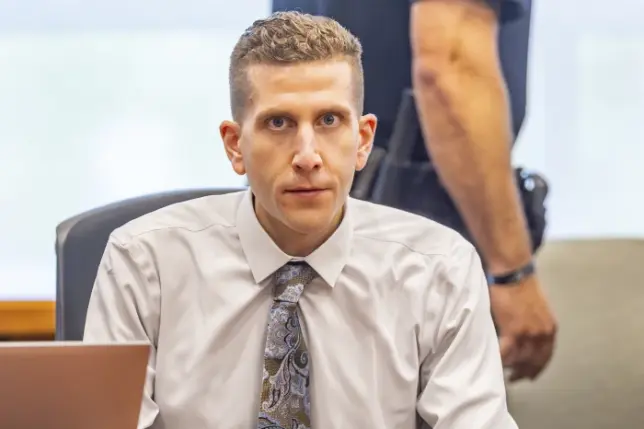
Kohberger was sentenced to serve four consecutive life sentences without parole for the brutal stabbing deaths of four University of Idaho students nearly three years ago.
Leavitt: Trump’s AI plan will ‘secure a brighter future for all Americans’
Trump’s press secretary Karoline Leavitt praised Trump’s new AI plan, which incorporates familiar pitches from tech lobbyists, during her press briefing.
She noted Trump will speak on the plan at an event later in the afternoon and said he’ll also sign three executive orders there.
“Under president Trump’s leadership, our country will lead the world in AI to secure a brighter future for all Americans, massively grow our economy and protect our national security,” Leavitt said.
Trump’s new AI plan leans heavily on Silicon Valley ideas
An artificial intelligence agenda that started coalescing on the podcasts of Silicon Valley billionaires is now being forged into U.S. policy as President Trump leans on the ideas of the tech figures who backed his election campaign.
The “AI Action Plan” revealed by the White House on Wednesday includes some familiar tech lobby pitches: Accelerating the sale of AI technology abroad and making it easier to construct energy-hungry data centers in the U.S.
It also includes some of the AI culture war preoccupations of the circle of venture capitalists who endorsed Trump last year.
▶Read more on Trump’s new AI plan
FEMA acting chief defends response to Texas floods
The acting administrator of the Federal Emergency Management Agency is pushing back on criticisms of the federal response to the central Texas floods that killed at least 135 people.
“I can’t see anything we did wrong,” FEMA acting administrator David Richardson told a House Committee on Transportation and Infrastructure subcommittee Wednesday morning, calling the relationship between state and federal agencies “a model for how disasters should be handled.”
Richardson denied reports that FEMA’s flood response was impaired by bureaucratic delays that slowed the deployment of urban search and rescue teams and left FEMA call centers unstaffed.
FEMA’s search and rescue leader, Ken Pagurek, resigned Monday.
The response “brought the maximum amount of capability to bear in Texas at the right time and the right place,” said Richardson.
Johnson says no need for House vote this week on Epstein records
Speaker Mike Johnson said the House doesn’t need to vote this week on releasing records related to the Jeffrey Epstein case because the Trump administration is “already doing everything within their power to release them.”
The comments come as Democratic repeatedly try to force votes on the matter, casting it as an issue of trust in the government. GOP leadership has also unveiled a resolution that has no legal weight but would urge the Justice Department to produce more documentation. None of those efforts will be brought before the House for a vote before lawmakers return home for the traditional August recess.
“There’s no point in passing a resolution to urge the administration to do something that they are already doing,” Johnson told reporters Wednesday. “That’s why we’re going to let that process play out.”
Johnson said that if the process for releasing the information stalls out, “then we’ll take appropriate action when everybody returns here, but we have to allow the court process to play out.”
As Trump targets Harvard, other Republicans take aim at higher education nationally
No government effort to influence a university — private or public — has gotten more attention than the clash at Harvard, where the Trump administration has frozen billions of dollars in federal funding as it seeks a series of policy changes. But far beyond the Ivy League, Republican officials are asserting control over public universities.
These conservatives in GOP-led states say colleges are out of touch, too liberal and loading students with too much debt. First they focused on the critical race theory that racism is embedded in the nation’s institutions. Then they went after diversity, equity and inclusion programs.
Since Trump took office, officials in states including Indiana, Florida, Ohio, Texas, Iowa and Idaho have sought control over university governance — the rules for who picks presidents and boards and how curricula and tenure are determined. As at Harvard, they’ve sought to reduce the power of faculty members and students.
▶ Read more about GOP efforts to reshape higher education
What are Americans thinking? Check out the new AP-NORC polling tracker
Wondering how Trump’s approval rating has changed, or where U.S. adults stand on trust in the Supreme Court, or whether they think climate change is happening?
Take a look at the new AP-NORC polling tracker, which shows the latest poll numbers as well as how they’ve changed over time. The tracker shows AP-NORC polling results going back as far as 2018. Go deep into the data and look at how the results break down by party, race, gender, and age.
The polling tracker shows shifts in public opinion on trust in institutions, favorability of Trump and Vance, the state of the country’s economy, and more.
The Trump administration has opposed international mandates on global warming
The United States and Russia, both of whom are major petroleum-producing states, are staunchly opposed to the court mandating emissions reductions.
But those who cling to fossil fuels could go broke doing it, the U.N. secretary-general told The Associated Press in an exclusive interview this week.
Simply having the court issue an opinion is the latest in a series of legal victories for the small island nations:
1. Earlier this month, the Inter-American Court of Human Rights found that countries have a legal duty not only to avoid environmental harm but also to protect and restore ecosystems.
2. Last year, the European Court of Human Rights ruled that countries must better protect their people from the consequences of climate change.
The UN’s top court delivers landmark decision on tackling climate change
The United Nations’ top court’s advisory opinion Wednesday declares that a “clean, healthy and sustainable environment” is a human right.
The International Court of Justice’s opinion describes the obligations of every nation to tackle climate change — and the consequences they may face if they don’t.
The non-binding opinion, which runs to over 500 pages, is seen as a potential turning point in international climate law. Enshrining a sustainable environment as a human right paves the way for other legal actions, including states returning to the ICJ to hold each other to account, as well as domestic lawsuits.
“The human right to a clean, healthy and sustainable environment is therefore inherent in the enjoyment of other human rights,” court President Yuji Iwasawa said.
▶ Read more about the UN court’s landmark climate ruling