AAA: PA Motorists Continue to See Lower Prices at the Pump

Photo of New Brighton Speedway sign by Frank Sparks

Gas prices are six cents lower in Western Pennsylvania this week at $3.339 per gallon, according to AAA East Central’s Gas Price Report.

Nationwide Trends:
The summer driving season is underway, and while gas prices normally peak this time of year, drivers are getting a reprieve. The national average for a gallon of regular is $3.12, down two cents from last week. Pump prices are 32 cents cheaper than last June, due to this year’s consistently low crude oil prices. Currently, oil supply in the market is outweighing demand. June gas prices haven’t been this low since 2021.

According to new data from the Energy Information Administration (EIA), gasoline demand decreased from 9.45 million barrels per day last week to 8.26. Total domestic gasoline supply increased from 223.1 million barrels to 228.3. Gasoline production decreased last week, averaging 9 million barrels per day.

At the close of Wednesday’s formal trading session, West Texas Intermediate fell 56 cents to settle at $62.85 a barrel. The EIA reports that crude oil inventories decreased by 4.3 million barrels from the previous week. At 436.1 million barrels, U.S. crude oil inventories are about 7% below the five-year average for this time of year.

The national average per kilowatt hour of electricity at a public EV charging station stayed the same this past week at 36 cents.

Western Pennsylvania Averages

Today

One Week Ago

One Year Ago

Record Price Date

Record Price

$3.339

$3.392

$3.817

6/13/2022

$5.029


The average price of unleaded self-serve gasoline today in various areas:      

$3.387      Altoona
$3.473      Beaver
$3.598      Bradford
$3.201      Brookville
$3.273      Butler
$3.351      Clarion
$3.227      DuBois
$3.109      Erie
$3.043      Greensburg
$3.417      Indiana
$3.121      Jeannette
$3.636      Kittanning
$2.933      Latrobe
$3.484      Meadville
$3.410      Mercer
$3.277      New Castle
$3.294      New Kensington
$3.429      Oil City
$3.416      Pittsburgh

$3.288      Sharon
$3.407      Uniontown
$3.696      Warren
$3.325      Washington
Quick Gas and Electricity Stats

Gas

The nation’s top 10 most expensive gasoline markets are California ($4.73), Hawaii ($4.47), Washington ($4.38), Oregon ($3.98), Nevada ($3.84), Alaska ($3.65), Illinois ($3.36), Idaho ($3.31), Utah ($3.30), and Arizona ($3.30).

The nation’s top 10 least expensive gasoline markets are Mississippi ($2.64), Louisiana ($2.72), Tennessee ($2.72), Alabama ($2.73), Oklahoma ($2.75), Texas ($2.75), Arkansas ($2.76), South Carolina ($2.77), Kentucky ($2.82), and North Carolina ($2.83).

Electric

The nation’s top 10 most expensive states for public charging per kilowatt hour are Alaska (50 cents), West Virginia (50 cents), Tennessee (48 cents), Hawaii (46 cents), Montana (45 cents), Louisiana (44 cents), South Carolina (43 cents), New Hampshire (42 cents), Kentucky (42 cents), and Arkansas (42 cents).

The nation’s top 10 least expensive states for public charging per kilowatt hour are Kansas (25 cents), Missouri (27 cents), Maryland (28 cents), Delaware (30 cents),  Nebraska (30 cents), Utah (30 cents), Iowa (32 cents), New Mexico (32 cents), Massachusetts (33 cents),  and Colorado (33 cents).

Motorists can find current gas prices nationwide, statewide, and countywide at gasprices.aaa.com.

Amazon to spend $20B on data centers in Pennsylvania, including one next to a nuclear power plant

FILE – A data center owned by Amazon Web Services, front right, is under construction next to the Susquehanna nuclear power plant in Berwick, Pa., on Tuesday, Jan. 14, 2024. (AP Photo/Ted Shaffrey, file)

HARRISBURG, Pa. (AP) — Amazon said Monday that it will spend $20 billion on two data center complexes in Pennsylvania, including one it is building alongside a nuclear power plant that has drawn federal scrutiny over an arrangement to essentially plug right into the power plant.

Kevin Miller, vice president of global data centers at Amazon’s cloud computing subsidiary, Amazon Web Services, told The Associated Press that the company will build another data center complex just north of Philadelphia.

One data center is being built next to northeastern Pennsylvania’s Susquehanna nuclear power plant, where it intends to get its power. The other will be in Fairless Hills at a logistics campus, the Keystone Trade Center, on what was once a U.S. Steel mill. Amazon said that data center will get its power through the electricity grid.

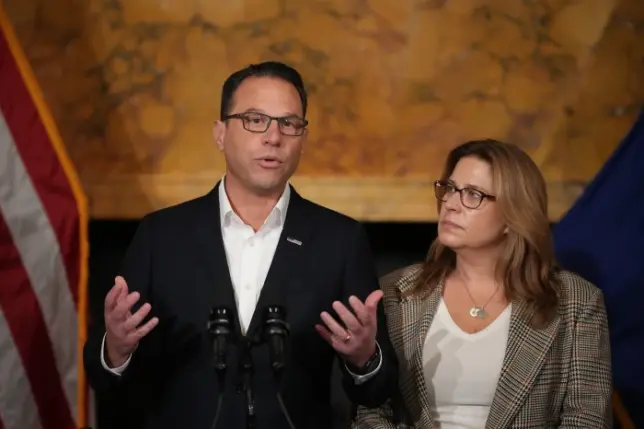
At a news conference in Berwick in the shadow of the power plant, Gov. Josh Shapiro called it the largest private sector investment in Pennsylvania’s history. Monday’s announcement, he said, is “just the beginning” because his administration is working with Amazon on additional data center projects in Pennsylvania.

While critics say data centers employ relatively few people and pack little long-term job-creation punch, their advocates say they require a huge number of construction jobs to build, spend enormous sums at area vendors and generate strong tax revenues for local governments.

Shapiro touted the work that will keep construction trades members busy building Amazon’s data centers, the tech jobs that will be waiting for graduates of area colleges and the millions of dollars in property taxes that will flow to schools and local governments.

“For too long, we’ve watched as talents across Pennsylvania got hollowed out and left behind,” Shapiro said at the news conference. “No more. Now is our time to rebuild those communities and invest in them. This investment in Pennsylvania starts reversing that trend.”

Pennsylvania will provide possibly tens of millions of dollars in incentives, typically a key element of data center deals as states compete for the large installations they hope will be an economic bonanza.

Shapiro’s administration said it will spend $10 million to pay for training classes and facilities at schools, community colleges and union halls to meet the skills demand for the data centers.

Amazon also will qualify for Pennsylvania’s existing sales tax exemption on purchases of data center equipment, such as servers and routers, an exemption that most states offer and that is viewed as a must-have for a state to compete.

The announcements add to the billions of dollars in Big Tech’s data center cash flowing into the state.

Since 2024 started, Amazon has committed to about $10 billion apiece to data center projects in MississippiIndianaOhio and North Carolina as it ramps up its infrastructure to compete with other tech giants to meet growing demand for artificial intelligence products.

The rapid growth of cloud computing and artificial intelligence has meanwhile fueled demand for energy-hungry data centers that need power to run servers, storage systems, networking equipment and cooling systems.

The majority owner of the Susquehanna nuclear power plant, Talen Energy, last year sold its data center and land adjacent to the plant to Amazon for $650 million in a deal to eventually provide 960 megawatts of electricity, likely at a premium. That’s 40% of the output of one of the nation’s largest nuclear power plants, or enough to power more than a half-million homes.

Amazon is effectively gutting that data center and building its own, larger facility on the land.

However, the power-supply arrangement between Talen and Amazon — called a “behind the meter” connection — has been held up by the Federal Energy Regulatory Commission in the first such case to come before the agency.

For Big Tech, plugging data centers directly into a power plant can take years off their development timelines and is a much faster route to procuring power than connecting to the congested electricity grid.

But it has raised questions over whether diverting power to higher-paying customers will leave enough for others and whether it’s fair to excuse big power users from paying fees to improve the grid.

It’s not clear when FERC, which blocked the deal on a procedural grounds, will decide the matter.

Already in Pennsylvania, Microsoft has a deal with the owner of the shuttered Three Mile Island nuclear power plant to restart a reactor under a 20-year agreement to supply its data centers in four states with energy.

Meanwhile, the owners of what was once Pennsylvania’s biggest coal-fired power plant say they will turn it into a $10 billion natural gas-powered data center campus.

Matt Vogt once chose dentistry over golf. Back home at the US Open, he’s learned he didn’t have to

Matt Vogt walks past the clubhouse to the first tee for a practice round for the 2025 US Open golf championship at Oakmont Country Club in Oakmont, Pa. Monday, June 9, 2025. (AP Photo/Gene J. Puskar)

PITTSBURGH (AP) — Matt Vogt was always going to be at the U.S. Open this week. The man who likes to plan had it all planned out.

He and his wife, Hilary, and their 15-month-old daughter, Charlotte, and their dogs would make the nearly six-hour drive from the Indianapolis suburbs and then crash at his mom’s house in Cranberry, about 20 minutes from Oakmont.

At some point, the 34-year-old knew he’d make it out to the course where he spent five-ish years caddying, a job whose perks included the opportunity to put a tee in the ground on Monday nights, something he admits now he didn’t do nearly often enough.

And the day after this year’s Open ended, Vogt would find himself back in the main office of the dental practice he opened in 2018.

That last part is still part of the plan, by the way.

It’s everything else about this trip that’s changed.

Three rounds of exquisitely steady golf — the kind Vogt found so elusive as a “hot-headed” 20-year-old that he left his college team to focus on his other passion instead — will do that.

So yes, Vogt will be at Oakmont this week after qualifying for the 125th edition of the national championship. In essentially his hometown, on a course that certainly feels like home on Father’s Day weekend, just two months after losing his father and biggest supporter, Jim, to colon cancer.

“This is pretty wild,” Vogt said on Monday while walking in for a news conference that carried on for more than 20 minutes, unheard of at a major tournament for an amateur with a respectable but hardly historic resume.

When “pipe dreams” become reality, it usually is.

Trading one passion for another

Vogt is a dreamer sure. Just a pragmatic one.

Even though he’s 6-foot-6. Even though he’s always been able to hit the ball a long, long way. Even though he’s long felt drawn to a game that requires discipline, focus and a touch of math, he never considered trying to make a living doing it.

By the time he graduated from Seneca Valley High School, an hour north of Pittsburgh in 2009, he was pretty sure he didn’t have “it.” A couple of years playing at Butler University reinforced what he held to be true: that he wasn’t prepared — physically or mentally — for the toll the game can take if you dedicate your life to chasing it.

So he took a break, a long one. He graduated with a degree in biology, then enrolled in dental school at the University of Indiana.

There was something about the combination of helping people, problem-solving and running his own business that appealed to him, even if he laughs now about all the things he didn’t know when The Dentists at Gateway Crossing opened its doors. Things like the fact that the rent is due even if those doors aren’t actually open yet.

“That was a freaky, freaky few months,” he said.

He quickly figured things out, and his practice steadily grew. Vogt now has another dentist on staff and has become an advisor to young doctors who want to follow the ambitious path he took.

Reorganized priorities

Around the same time Vogt’s practice opened, he made himself a promise.

“Don’t look back and be the guy, ‘Well, if I had just done this or that, I maybe could have done great things,’” he said.

He’s not sure why he started hitting balls with a purpose again in 2018. It just kind of happened. He quickly became a fixture on the Indiana amateur circuit and qualified for the 2021 U.S. Amateur at Oakmont but didn’t make it out of stroke play. The first number of his score was an eight, and the second was either one or two, and to be honest, he’s fine not being totally sure.

The disappointment didn’t linger. He shot 67 at the alternate site the next day. Not enough of a rally to become one of the top 64 who advanced to match play, but telling of the ever-increasing maturity of both his game and his approach.

Having a job, having a family to support, playing because he wanted to, not because he had to, shifted his perspective. He’s no longer a golfer first. At this point in his life, that might not even crack the top five behind Christian, father and husband, among others.

“One of the biggest changes is, I’ve gotten my priorities right,” he said.

Bombs away

Some things, however, have not changed. At least on the course. Vogt hits it far. How far? He ran into long drive champion/influencer Kyle Berkshire at a pro-am a few months after the 2021 U.S. Amateur.

Berkshire saw enough to invite Vogt out to Nevada to see if he could qualify for a long drive competition. While he didn’t quite reach the world championships, he did unleash a 466-yard missile that drifted out of bounds.

He had a blast, but also realized he was running the risk of spreading himself too thin. So he took what he learned and incorporated it into his skillset. It’s one of the reasons he opted to try to qualify for this year’s U.S. Open by picking a route that included a sectional at Wine Valley Golf Club in Walla Walla, Washington.

The “math and science geek” had done his research. He knew Wine Valley was wide enough that he probably wouldn’t run into trouble if he started spraying tee shots. He captured medalist honors after back-to-back 4-under 68s.

And suddenly, the dentist from Indiana was on The Golf Channel, his emotional post-round video going viral and his phone blowing up to the point that he asked Hillary to help him keep track of it all. Things got so busy last week that when Vogt tried to sneak out to practice, it wasn’t until he was nearly at the course that he realized he’d forgotten his shoes.

A grateful heart

Vogt’s soft spikes were back in their usual spot when he stepped off the first tee on a Monday unlike any of the others he’d ever experienced at Oakmont.

This time, he wasn’t slinging it in the twilight with the other caddies. Instead, he was walking down the fairways with good friend and occasional tournament partner Kevin O’Brien on his bag, saying hello to familiar faces on the other side of the ropes while he signed autographs, his father never far from his mind.

Jim Vogt was diagnosed with colon cancer last July. Less than a year later, he’s gone. Vogt — who is wearing a blue ribbon on his baseball cap for colon cancer awareness — is still processing it. He is pressing on and trying to lean into the joy along the way.

“I think this weekend is going to be full of gratitude,” he said. “And hopefully some good golf, too.”

Pentagon draws up rules on possible use of force by Marines deployed to LA protests

U.S. Defense Secretary Pete Hegseth salutes during a ceremony at the US cemetery to commemorate the 81st anniversary of the D-Day landings, Friday, June 6, 2025 in Colleville-sur-Mer, Normandy. (AP Photo/Thomas Padilla)

WASHINGTON (AP) — The Pentagon was scrambling Monday to establish rules to guide U.S. Marines who could be faced with the rare and difficult prospect of using force against citizens on American soil, now that the Trump administration is deploying active duty troops to the immigration raid protests in Los Angeles.

U.S. Northern Command said it is sending 700 Marines into the Los Angeles area to protect federal property and personnel, including federal immigration agents. The 2nd Battalion, 7th Marines are coming from Twentynine Palms, California, and will augment about 4,100 National Guard members already in LA or authorized to be deployed there to respond to the protests.

The forces have been trained in deescalation, crowd control and standing rules for the use of force, Northern Command said.

But the use of the active duty forces still raises difficult questions.

The Marines are highly trained in combat and crisis response, with time in conflict zones like Syria and Afghanistan. But that is starkly different from the role they will face now: They could potentially be hit by protesters carrying gas canisters and have to quickly decide how to respond or face decisions about protecting an immigration enforcement agent from crowds.

According to a U.S. official, troops will be armed with their normal service weapons but will not be carrying tear gas. They also will have protective equipment such as helmets, shields and gas masks.

When troops are overseas, how they can respond to threats is outlined by the rules of engagement. At home, they are guided by standing rules for the use of force, which have to be set and agreed to by Northern Command, and then each Marine should receive a card explaining what they can and cannot do, another U.S. official said.

For example, warning shots would be prohibited, according to use-of-force draft documents viewed by The Associated Press. Marines are directed to deescalate a situation whenever possible but also are authorized to act in self-defense, the documents say.

The AP reviewed documents and interviewed nine U.S. officials, who spoke on condition of anonymity to discuss details not yet public, about the guidance being determined for the Marines.

The Pentagon also is working on a memo with clarifying language for the Marines that will lay out the steps they can take to protect federal personnel and property. Those guidelines also will include specifics on the possibility that they could temporarily detain civilians if troops are under assault or to prevent harm, the first U.S. official said.

Those measures could involve detaining civilians until they can be turned over to law enforcement.

Having the Marines deploy to protect federal buildings allows them to be used without invoking the Insurrection Act, one U.S. official said.

The Insurrection Act allows the president to direct federal troops to conduct law enforcement functions in national emergencies. But the use of that act is extremely rare. Officials said that has not yet been done in this case and that it’s not clear it will be done.

President George H.W. Bush used the Insurrection Act to respond to riots in Los Angeles in 1992 after the acquittal of white police officers who were videotaped beating Black motorist Rodney King.

If their role expands if the violence escalates, it is not clear under what legal authority they would be able to engage, said Elizabeth Goitein, a senior director of the Liberty and National Security Program at the Brennan Center for Justice at NYU Law.

“If in fact those Marines are laying hands on civilians, doing searches, then you have pretty powerful legal concerns,” Goitein said. “No statutory authority Trump has invoked so far permits this.”

Defense Secretary Pete Hegseth tweeted late Saturday that he was considering deploying the Marines to respond to the unrest after getting advice earlier in the day from Gen. Dan Caine, chairman of the Joint Chiefs of Staff, according to one of the U.S. officials.

Still, the tweet, which was posted to Hegseth’s personal X account and not to his official government account, caught many inside the Pentagon by surprise. As late as Monday, the military’s highest offices were still considering the potential ramifications.

But the Marine Corps were asking broader questions, too: Do they send more senior, experienced personnel so as not to put newer, less experienced troops at risk of potentially making a judgment call on whether to use force against a civilian?

What’s lawful under a domestic deployment — where troops may end up in a policing role — is governed by the Fourth Amendment in the U.S. Constitution, which forbids seizure of persons, including temporarily restraining them, unless it could be considered reasonable under the circumstances.

Troops under federal authorities are in general prohibited from conducting law enforcement on U.S. soil under the Posse Comitatus Act.

RFK Jr. ousts entire CDC vaccine advisory committee

FILE – Health and Human Services Secretary Robert F. Kennedy Jr. speaks during a news conference on the Autism report by the CDC at the Hubert Humphrey Building Auditorium in Washington, April 16, 2025. (AP Photo/Jose Luis Magana, File)

Health Secretary Robert F. Kennedy Jr. on Monday removed every member of a scientific committee that advises the Centers for Disease Control and Prevention on how to use vaccines and pledged to replace them with his own picks.

Major physicians and public health groups criticized the move to oust all 17 members of the Advisory Committee on Immunization Practices.

Kennedy, who was one of the nation’s leading anti-vaccine activists before becoming the nation’s top health official, has not said who he would appoint to the panel, but said it would convene in just two weeks in Atlanta.

Although it’s typically not viewed as a partisan board, the entire current roster of committee members were Biden appointees.

“Without removing the current members, the current Trump administration would not have been able to appoint a majority of new members until 2028,” Kennedy wrote in a Wall Street Journal opinion piece. “A clean sweep is needed to re-establish public confidence in vaccine science.”

When reached by phone, the panel’s now-former chair — Dr. Helen Keipp Talbot of Vanderbilt University — declined to comment. But another panel member, Noel Brewer at the University of North Carolina, said he and other committee members received an email late Monday afternoon that said their services on the committee had been terminated but gave no reason.

“I’d assumed I’d continue serving on the committee for my full term,” said Brewer, who joined the panel last summer.

Brewer is a behavioral scientist whose research examines why people get vaccinated and ways to improve vaccination coverage. Whether people get vaccinated is largely influenced by what their doctors recommend, and doctors have been following ACIP guidance.

“Up until today, ACIP recommendations were the gold standard for what insurers should pay for, what providers should recommend, and what the public should look to,” he said.

But Kennedy already took the unusual step of changing COVID-19 recommendations without first consulting the committee — a move criticized by doctors’ groups and public health advocates.

“It’s unclear what the future holds,” Brewer said. “Certainly provider organizations have already started to turn away from ACIP.”

Kennedy said the committee members had too many conflicts of interest. Currently, committee members are required to declare any potential such conflicts, as well as business interests, that arise during their tenure. They also must disclose any possible conflicts at the start of each public meeting.

But Dr. Tom Frieden, president and CEO of Resolve to Save Lives and former director of the Centers for Disease Control and Prevention, said Kennedy’s actions were based on false conflict-of-interest claims and set “a dangerous and unprecedented action that makes our families less safe” by potentially reducing vaccine access for millions of people.

“Make no mistake: Politicizing the ACIP as Secretary Kennedy is doing will undermine public trust under the guise of improving it,” he said in a statement. “We’ll look back at this as a grave mistake that sacrificed decades of scientific rigor, undermined public trust, and opened the door for fringe theories rather than facts.”

Dr. Georges Benjamin, executive director of the American Public Health Association, called Kennedy’s mass ouster “a coup.”

“It’s not how democracies work. It’s not good for the health of the nation,” Benjamin told The Associated Press.

Benjamin said the move raises real concerns about whether future committee members will be viewed as impartial. He added that Kennedy is going against what he told lawmakers and the public, and the public health association plans to watch Kennedy “like a hawk.”

“He is breaking a promise,” Benjamin said. “He said he wasn’t going to do this.”

Dr. Bruce A. Scott, president of the American Medical Association, called the committee a trusted source of science- and data-driven advice and said Kennedy’s move, coupled with declining vaccination rates across the country, will help drive an increase in vaccine-preventable diseases.

“Today’s action to remove the 17 sitting members of ACIP undermines that trust and upends a transparent process that has saved countless lives,” Scott said in a statement.

Republican Sen. Bill Cassidy of Louisiana, a doctor who had expressed reservations about Kennedy’s nomination but voted to install him as the nation’s health secretary nonetheless, said he had spoken with Kennedy moments after the announcement.

“Of course, now the fear is that the ACIP will be filled up with people who know nothing about vaccines except suspicion,” Cassidy said in a social media post. “I’ve just spoken with Secretary Kennedy, and I’ll continue to talk with him to ensure this is not the case.”

The committee had been in a state of flux since Kennedy took over. Its first meeting this year had been delayed when the U.S. Department of Health and Human Services abruptly postponed its February meeting.

During Kennedy’s confirmation, Cassidy had expressed concerns about preserving the committee, saying he had sought assurances that Kennedy would keep the panel’s current vaccine recommendations.

The webpage that featured the committee’s members was deleted Monday evening, shortly after Kennedy’s announcement.

___

Associated Press writers Zeke Miller, Devi Shastri and Mike Stobbe contributed.

___

The Associated Press Health and Science Department receives support from the Howard Hughes Medical Institute’s Science and Educational Media Group and the Robert Wood Johnson Foundation. The AP is solely responsible for all content.

Sly Stone, leader of funk revolutionaries Sly and the Family Stone, dies at 82

FILE – Rock star Sylvester “Sly” Stone of Sly and the Family Stone, April 1972. (AP Photo, File)

NEW YORK (AP) — Sly Stone, the revolutionary musician and dynamic showman whose Sly and the Family Stone transformed popular music in the 1960s and ’70s and beyond with such hits as “Everyday People,” “Stand!” and “Family Affair,” died Monday at age 82

Stone, born Sylvester Stewart, had been in poor health in recent years. His publicist Carleen Donovan said Stone died in Los Angeles surrounded by family after contending with chronic obstructive pulmonary disease and other ailments.

Founded in 1966-67, Sly and the Family Stone was the first major group to include Black and white men and women, and well embodied a time when anything seemed possible — riots and assassinations, communes and love-ins. The singers screeched, chanted, crooned and hollered. The music was a blowout of frantic horns, rapid-fire guitar and locomotive rhythms, a melting pot of jazz, psychedelic rock, doo-wop, soul and the early grooves of funk.

Sly’s time on top was brief, roughly from 1968-1971, but profound. No band better captured the gravity-defying euphoria of the Woodstock era or more bravely addressed the crash which followed. From early songs as rousing as their titles — “I Want To Take You Higher,” “Stand!” — to the sober aftermath of “Family Affair” and “Runnin’ Away,” Sly and the Family Stone spoke for a generation whether or not it liked what they had to say.

Stone’s group began as a Bay Area sextet featuring Sly on keyboards, Larry Graham on bass; Sly’s brother, Freddie, on guitar; sister Rose on vocals; Cynthia Robinson and Jerry Martini horns and Greg Errico on drums. They debuted with the album “A Whole New Thing” and earned the title with their breakthrough single, “Dance to the Music.” It hit the top 10 in April 1968, the week the Rev. Martin Luther King was murdered, and helped launch an era when the polish of Motown and the understatement of Stax suddenly seemed of another time.

Led by Sly Stone, with his leather jumpsuits and goggle shades, mile-wide grin and mile-high Afro, the band dazzled in 1969 at the Woodstock festival and set a new pace on the radio. “Everyday People,” “I Wanna Take You Higher” and other songs were anthems of community, non-conformity and a brash and hopeful spirit, built around such catchphrases as “different strokes for different folks.” The group released five top 10 singles, three of them hitting No. 1, and three million-selling albums: “Stand!”, “There’s a Riot Goin’ On” and “Greatest Hits.”

For a time, countless performers wanted to look and sound like Sly and the Family Stone. The Jackson Five’s breakthrough hit, “I Want You Back,” and the Temptations’ “I Can’t Get Next to You” were among the many songs from the late 1960s that mimicked Sly’s vocal and instrumental arrangements. Miles Davis’ landmark blend of jazz, rock and funk, “Bitches Brew,” was inspired in part by Sly, while fellow jazz artist Herbie Hancock even named a song after him.

“He had a way of talking, moving from playful to earnest at will. He had a look, belts, and hats and jewelry,” Questlove wrote in the foreword to Stone’s memoir, “Thank You (Falettinme Be Mice Elf Agin),” named for one of his biggest hits and published through Questlove’s imprint in 2023. “He was a special case, cooler than everything around him by a factor of infinity.”

In 2025, Questlove released the documentary “Sly Lives! (aka The Burden of Black Genius).”

Sly’s influence has endured for decades. The top funk artist of the 1970s, Parliament-Funkadelic creator George Clinton, was a Stone disciple. Prince, Rick James and the Black Eyed Peas were among the many performers from the 1980s and after shaped in part by Sly, and countless hip-hop artists have sampled his riffs, from the Beastie Boys to Dr. Dre and Snoop Dogg. A 2005 tribute record included Maroon 5, John Legend and the Roots.

“Sly did so many things so well that he turned my head all the way around,” Clinton once wrote. “He could create polished R&B that sounded like it came from an act that had gigged at clubs for years, and then in the next breath he could be as psychedelic as the heaviest rock band.”

A dream dies, a career burns away

By the early ’70s, Stone himself was beginning a descent from which he never recovered, driven by the pressures of fame and the added burden of Black fame. His record company was anxious for more hits, while the Black Panthers were pressing him to drop the white members from his group. After moving from the Bay Area to Los Angeles in 1970, he became increasingly hooked on cocaine and erratic in his behavior. A promised album, “The Incredible and Unpredictable Sly and the Family Stone” (“The most optimistic of all,” Rolling Stone reported) never appeared. He became notorious for being late to concerts or not showing up at all, often leaving “other band members waiting backstage for hours wondering whether he was going to show up or not,” according to Stone biographer Joel Selvin.

Around the country, separatism and paranoia were setting in. As a turn of the calendar, and as a state of mind, the ’60s were over. “The possibility of possibility was leaking out,” Stone later explained in his memoir.

On “Thank You (Falettinme Be Mice Elf Agin),” Stone had warned: “Dying young is hard to take/selling out is harder.” Late in 1971, he released “There’s a Riot Going On,” one of the grimmest, most uncompromising records ever to top the album charts. The sound was dense and murky (Sly was among the first musicians to use drum machines), the mood reflective (“Family Affair”), fearful (“Runnin’ Away”) and despairing: “Time, they say, is the answer — but I don’t believe it,” Sly sings on “Time.” The fast, funky pace of the original “Thank You (Falettinme Be Mice Elf Agin)” was slowed, stretched and retitled “Thank You For Talkin’ to Me, Africa.”

The running time of the title track was 0:00.

“It is Muzak with its finger on the trigger,” critic Greil Marcus called the album.

“Riot” highlighted an extraordinary run of blunt, hard-hitting records by Black artists, from the Stevie Wonder single “Superstition” to Marvin Gaye’s “What’s Going On” album, to which “Riot” was an unofficial response. But Stone seemed to back away from the nightmare he had related. He was reluctant to perform material from “Riot” in concert and softened the mood on the acclaimed 1973 album “Fresh,” which did feature a cover of “Que Sera Sera,” the wistful Doris Day song reworked into a rueful testament to fate’s upper hand.

By the end of the decade, Sly and the Family Stone had broken up and Sly was releasing solo records with such unmet promises as “Heard You Missed Me, Well I’m Back” and “Back On the Right Track.” Most of the news he made over the following decades was of drug busts, financial troubles and mishaps on stage. Sly and the Family Stone was inducted into the Rock & Roll of Fame in 1993 and honored in 2006 at the Grammy Awards, but Sly released just one album after the early ’80s, “I’m Back! Family & Friends,” much of it updated recordings of his old hits.

He would allege he had hundreds of unreleased songs and did collaborate on occasion with Clinton, who would recall how Stone “could just be sitting there doing nothing and then open his eyes and shock you with a lyric so brilliant that it was obvious no one had ever thought of it before.”

Sly Stone had three children, including a daughter with Cynthia Robinson, and was married once — briefly and very publicly. In 1974, he and actor Kathy Silva wed on stage at Madison Square Garden, an event that inspired an 11,000-word story in The New Yorker. Sly and Silva soon divorced.

A born musician, a born uniter

He was born Sylvester Stewart in Denton, Texas, and raised in Vallejo, California, the second of five children in a close, religious family. Sylvester became “Sly” by accident, when a teacher mistakenly spelled his name “Slyvester.”

He loved performing so much that his mother alleged he would cry if the congregation in church didn’t respond when he sang before it. He was so gifted and ambitious that by age 4 he had sung on stage at a Sam Cooke show and by age 11 had mastered several instruments and recorded a gospel song with his siblings. He was so committed to the races working together that in his teens and early 20s he was playing in local bands that included Black and white members and was becoming known around the Bay Area as a deejay equally willing to play the Beatles and rhythm and blues acts.

Through his radio connections, he produced some of the top San Francisco bands, including the Great Society, Grace Slick’s group before she joined the Jefferson Airplane. Along with an early mentor and champion, San Francisco deejay Tom “Big Daddy” Donahue, he worked on rhythm and blues hits (Bobby Freeman’s “C’mon and Swim”) and the Beau Brummels’ Beatle-esque “Laugh, Laugh.” Meanwhile, he was putting together his own group, recruiting family members and local musicians and settling on the name Sly and the Family Stone.

“A Whole New Thing” came out in 1967, soon followed by the single “Dance to the Music,” in which each member was granted a moment of introduction as the song rightly proclaimed a “brand new beat.” In December 1968, the group appeared on “The Ed Sullivan Show” and performed a medley that included “Dance to the Music” and “Everyday People.” Before the set began, Sly turned to the audience and recited a brief passage from his song “Are You Ready”:

“Don’t hate the Black,

don’t hate the white,

if you get bitten,

just hate the bite.”

Anthony David Snowden Sr. (11/10/62-06/04/25)

Anthony David Snowden Sr., 62, of Beaver Falls, peacefully passed away at his residence on Wednesday, June 4, 2025. Born on November 10, 1962, in Beaver Falls, he was the beloved son of the late Richard David Snowden and Lillian (Hobson) Snowden. Anthony proudly served his country for thirteen years in the United States military. After completing his military service, he accepted Christ as his personal saviour and committed his life to being a good and faithful soldier in the army of the Lord Jesus Christ, fighting the good fight of faith! Anthony was also a faithful member of Christ Temple Church of God in Christ, where he served as both a trustee and a deacon – roles he held with honor, dignity, and humility. Anthony—affectionately known as Tony—was a man of unwavering faith, whose every action was rooted in his deep relationship with God. He was known for his powerful yet uplifting words, generous spirit, and compassionate heart. One of his greatest joys was sitting and listening to the gospel group “Men of Standard”, letting their music minister to his soul. He is survived by his two sons, Anthony Richard Snowden Jr. and Joshua David Snowden; four loving sisters, Victoria Anne Snowden, Carla M. Snowden, his twin sister, Antoinette Faye (Tyrone) Williams, and Jennifer J. Snowden; two nephews, David (Marcie) Alford, of Rochester, PA. Richard “Spike” (Charnelle) Williams of Detroit, MI, a niece, India (Jared) Davis of Ypsilanti, MI., three great-nephews, Mason and Rhoman Alford of Rochester, PA., and Carter Davis of Ypsilanti, MI., three great-nieces, Sage, Savannah, and Summer Williams of. Detroit, MI., along with a host of many cousins and cherished friends. In addition to his parents, Anthony was preceded in death by his sister, Sandra G. Alford, and his brother, Michael David Snowden. A memorial visitation will be held Wednesday from 11 am until the time of service at 12 PM at Christ Temple Church of God in Christ, 2420 9th Ave, Beaver Falls, PA 15010.

Teddy L. Lechok (06/07/1958 to 06/04/2025)

Teddy L. Lechok, 66, of Midland, passed away on June 4, 2025, at home, surrounded by his loving family.
Born on June 7, 1958, in Sewickley, PA, he was the son of the late Ted and Helen “Kathy” Lechok. Teddy owned and operated Ted’s Auto Service and Parts in Ohioville for nearly 30 years, and was a follower of Christ, driven by the Holy Spirit, having eternal life. He was an avid gear head, car enthusiast and survivalist. His skills included welding, heavy equipment operation, mechanics and towing. He was kind to all and a good friend to many.
Along with his parents, Teddy is preceded in death by his brother, Ronald Auen.
Teddy will be sadly missed by his beloved wife of 49 years, Renae; son, Jesse Lechok, of Charleroi, PA; daughter, Sabrina (Aaron Draa) Rummell; granddaughter, Sienna Rummell; and numerous cousins, nieces, and nephews.
Friends will be received on Thursday June 12, 2025 from 2pm until the time of service at 6pm in the Schwerha-Noll Funeral Home Inc., 629 Midland Avenue, Midland PA 15059. Online condolences may be shared at www.nollfuneral.com.

Grace Marie Zapsic (04/ 25/1935 to 06/05/2025)

It is with much sorrow that the family of Grace Marie Mutkus Zapsic, age 90 of Midland, announces her passing on June 5, 2025, at Good Samaritan Hospice in Wexford, with her daughter, Michelle, by her side.

Born on April 25, 1935, in Independence Township, she was the daughter of the late Alexander and Florene Parrish Mutkus. Growing up on a farm with her eight brothers and sisters, Grace developed an appreciation for outdoor activities. She was an exceptionally devoted wife, mother, and grandmother, and loved nothing more than spending time with her family. Her husband, Don, is certain that her good cooking– especially her coconut cream pies– kept him alive for the 72 years of their marriage!

Grace was preceded in death by her brothers Richard, Raymond, Thomas, and Norman, and a sister, Alice Giralico.

She will be lovingly remembered by her husband Donald Zapsic, whom she married on September 16, 1953; her daughters, Michelle Perkins (Wayne) and Patti Brandon (Tim), her sons, Stephen Zapsic (Frances) and Donald Zapsic, Jr. (Millie); nine grandchildren, eleven great grandchildren, and one great, great granddaughter; her brother, Alex Mutkus (Nancy) and two sisters, Nancy MacDonald (Mark) and Eileen Hramika (Patrick); and many nieces and nephews.

The family would like to express their appreciation to Linda Zapsic, Leah Perkins and Good Samaritan Hospice for their loving care and concern for Grace.

Visitation will be at the Schwerha-Noll Funeral Home, 629 Midland Ave, Midland, PA 15059 on Monday, June 9, from 2:00 – 8:00 p.m. A funeral service will be held on Tuesday, June 10 at 10:30 a.m. at the St. Augustine parish/ St. Blaise Catholic Church, 772 Ohio Ave., Midland, PA 15059.

Online condolences may be shared at www.nollfuneral.com.