

Beaver County Radio
BEAVER — As the United States celebrates its 250th anniversary, a team of developers is using advanced technology to resurrect a vanished piece of America’s frontier history.
Immersive Beaver, a new volunteer-led initiative making interactive media for local museums, announced its partnership with the Beaver Area Heritage Museum to develop a historically informed digital twin of Fort McIntosh for use as an in-person exhibit.
Built in 1778 along the Ohio River in present-day Beaver, the fort was a consequential Revolutionary War outpost and the site of significant treaty negotiations. It is also recognized as the birthplace of the United States Army in peacetime. While the physical structure disappeared centuries ago, this new reconstruction will allow the public to explore the fort as it may have stood all those years ago.
The upcoming digital exhibit was introduced at the museum July 4 as the nation commemorated the 250th anniversary of the signing of the Declaration of Independence. Visitors received a preview of the work-in-progress experience, which is planned to become a permanent museum installation in 2028, marking
the 250th anniversary of Fort McIntosh. While the project has reached an important milestone, significant historical research, 3D modeling, programming, and exhibit development remain.
Immersive Beaver is actively seeking volunteer historians, artists and engineers, as well as financial supporters to help enhance the experience and ensure it remains freely accessible to the public through the Beaver Area Heritage Museum.
“Our team is excited to unveil our work to bring Fort McIntosh back to life, built by hand on an accurate digital landscape of Beaver,” said Robert Belle-Isle of Immersive Beaver. “We are using revolutionary approaches to give people the chance to see something that has not been seen in centuries.”
The reconstruction is a serious historical and educational undertaking. The Immersive Beaver team will use archival evidence, historical maps and archaeological data to build the environment. Given the ambiguity of historical data from the time, a complete interpretation is not possible. However, the digital space helps the team test competing historical interpretations.
“I have always been drawn to the idea that new technology can help us reach backward, not just forward. We usually talk about innovation in terms of creating the future, but it can also give us extraordinary new ways to recover, preserve and understand the past,” said Ryan O’Shea of Immersive Beaver.
“We are in the business of making history accessible to everyone from children to adults,” said Mark Miner, chairman of the Beaver Area Heritage Museum. “This digital reconstruction allows us to pull the fragments of a rather scattered history together in a truly immersive way so that you can really visualize in an all new format what it felt like to be at the fort. And by doing this, we are going to make history as accessible as possible, not only for today but for future generations.”
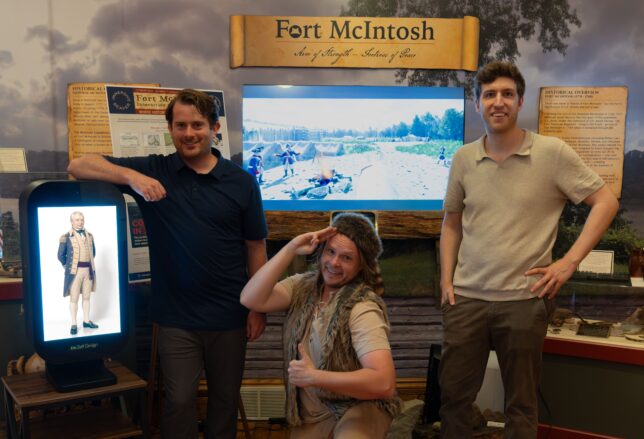
displaying the team’s digital reconstruction of Fort McIntosh during the project’s public unveiling at the Beaver
Area Heritage Museum in Beaver, on July 4, 2026. The historically informed 3D environment is
being developed for a planned permanent museum installation in 2028, the 250th anniversary of the fort’s
construction.
About Immersive Beaver
Immersive Beaver is an ambitious volunteer-led organization that partners with small local museums to develop state-of-the-art exhibits and immersive experiences. By bringing together engineers, artists, historians and educators, the organization creates opportunities for volunteers to apply their professional skills in service of their communities.
Immersive Beaver is actively accepting volunteers to help develop the Fort McIntosh digital reconstruction and future museum projects. The organization welcomes software developers, digital artists, grant writers, researchers and anyone interested in applying their skills to create innovative museum experiences for their local communities.
To start your adventure with Immersive Beaver, visit: immersivebeaver.org
Support the Fort McIntosh Project
The Fort McIntosh reconstruction is made possible through community support. Donations directly fund historical research, software and equipment costs, exhibit development and the permanent installation at the Beaver Area Heritage Museum. Additional funding will directly expand the scope and depth of the experience, enabling more detailed environments, enhanced interactive features, and a richer, more engaging visitor experience.
As a one-time recognition, supporters who contribute during the project’s early development will have their names permanently displayed on an Early Supporters Monument within the digital exhibit.
To support the project, visit: beaverheritage.org/